

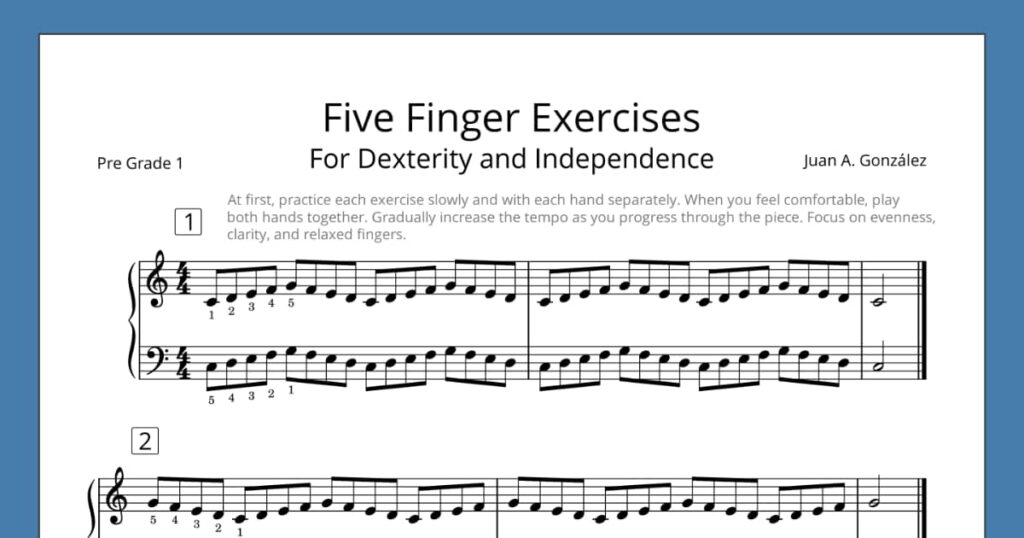
If you’re new to piano, five finger exercises are one of the most effective ways to build finger strength, coordination, and confidence at the keyboard. These simple patterns train your fingers to move independently, improve accuracy, and prepare you for more complex repertoire.
In this guide, you’ll find beginner-friendly piano finger exercises you can practice daily, plus tips on how to practice them correctly.
What are 5 finger exercises?
They are short patterns that use all five fingers of each hand within a five-note range. They help beginners:
- Develop finger independence
- Improve hand coordination
- Strengthen weak or underused fingers
- Build confidence for reading and playing music
These exercises are simple in structure but powerful in results, making them ideal for beginners.
Five-finger practice sheet for beginners
I wrote this five finger exercise sheet (PDF) to practice daily and improve finger dexterity and independence:
How to practice five finger exercises the right way
Practicing correctly is more important than practicing a lot. Use this simple approach:
Sit comfortably and stay relaxed
Good posture helps your fingers move freely. Sit at the edge of the bench with your shoulders and wrists relaxed.
Use a slow and steady tempo
Start slowly. Speed will come later. Accuracy and control come first.
Keep fingers curved and close to the keys
Curved fingers give you better control and help avoid unnecessary tension.
Breathe and release tension
If you feel tension in your hands or shoulders, stop and reset before continuing.
Five finger exercise patterns for beginners
The following exercises focus on two essential skills: finger dexterity and finger independence. Practice them daily for 5–10 minutes.
Dexterity exercises: hands together
Dexterity exercises train evenness and control by playing the same pattern with both hands at the same time.
Start with this basic five-note pattern:
- Right hand: C – D – E – F – G
- Left hand: C – D – E – F – G
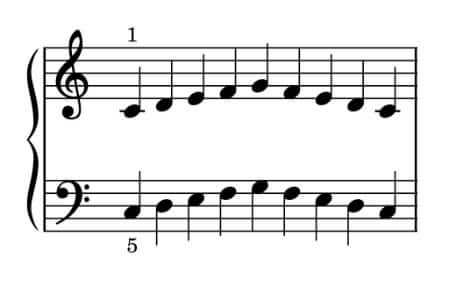
Play hands together, slowly and evenly, listening for equal tone in every finger.
These types of exercises appear frequently in classic beginner methods, such as Preparatory Exercises Op. 16 by Aloys Schmitt, which uses simple five-finger positions to develop coordination and finger control.
You can practice this pattern using printable practice sheets in a five-note range before moving on to repertoire.
Finger independence exercises
Finger independence exercises help each finger move on its own while the others remain stable.
Try this simple pattern:
C – E – D – F – E – G – F – E – D – C
Focus on keeping all fingers close to the keys and avoiding unnecessary movement.
Another effective approach is to hold some fingers down while others play. For example:
- Hold C and G while playing D – E – F
- Switch fingers and repeat
These types of independence drills are also found in Schmitt’s Op. 16 and similar preparatory studies.
Transposing five finger patterns
Once comfortable, move the same patterns to other starting notes:
- D – E – F – G – A
- E – F – G – A – B
This builds keyboard awareness and prepares you to play in different keys.
How often should you practice five finger exercises?
Consistency matters more than duration. Even a short daily routine can lead to noticeable improvement.
Common mistakes to avoid
- Playing too fast too soon
- Practicing with stiff fingers or wrists
- Looking only at your hands instead of the music
- Ignoring evenness and tone quality
Focus on control, relaxation, and clarity rather than speed.
Related content:
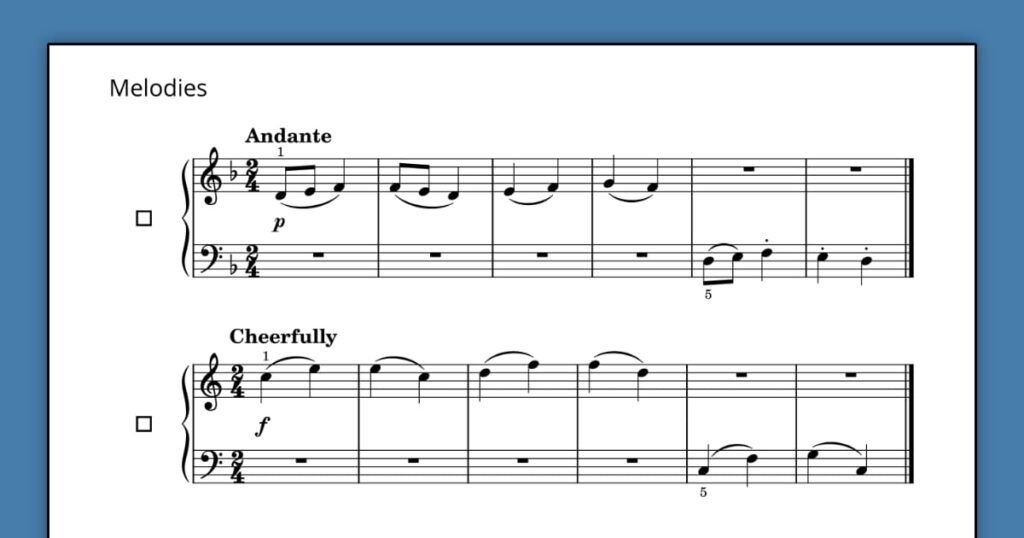
Sight-Reading Tips for Beginners
Sight-reading
Here, you’ll find tips and free practice sheets to help you get started.
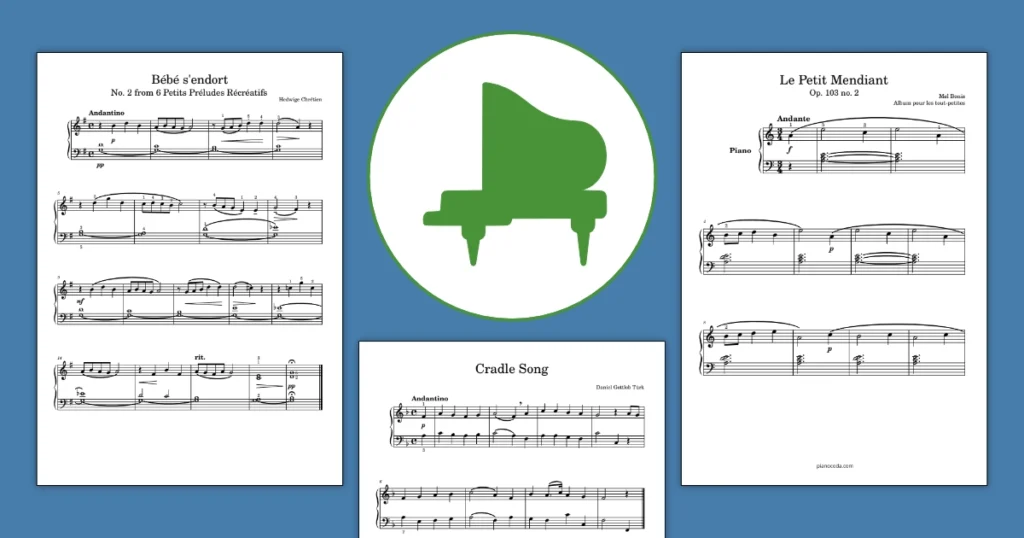
Top 10 Beginner Pieces + Scores to Start Playing Today
Best pieces
Discover the 10 easiest pieces with downloadable PDFs and audio recordings.