

An analysis of 30 popular “beginner” scores suggests that they are significantly more advanced than anticipated.
Methodology
To evaluate the accuracy of “Beginner” labels, we reviewed 30 of the most-viewed piano scores categorized as “Beginner” on a major user-generated sheet music platform, including MuseScore.
Each piece was compared against grading standards from established examination boards, including:
- ABRSM
- RCM (Royal Conservatory of Music)
- Trinity College London
- AMEB
Understanding difficulty in piano pieces
What is considered a beginner piano piece?
For the purpose of this analysis, “Beginner” level is defined using these grading systems, typically covering Preparatory to Grade 2 (or equivalent). Grades 3 and above were classified as early-intermediate or higher.
While beginner repertoire is often associated with the early stages of learning, progression can vary significantly between individuals. For consistency and comparability, this analysis relies on formal grading systems rather than estimated learning time.
When available, we recorded the corresponding grade for each system and classified each piece as “Beginner” based on these thresholds.
We consider “Beginner” pieces to be those graded within the early levels of major exam systems, including (but not limited to):
- RCM Grade prep A
- RCM Grade prep B
- RCM Grade 1
- RCM Grade 2
- AMEB Initial Grade
- AMEB Grade 1
- AMEB Grade 2
- ABRSM Initial
- ABRSM Grade 1
- ABRSM Grade 2
Key Findings
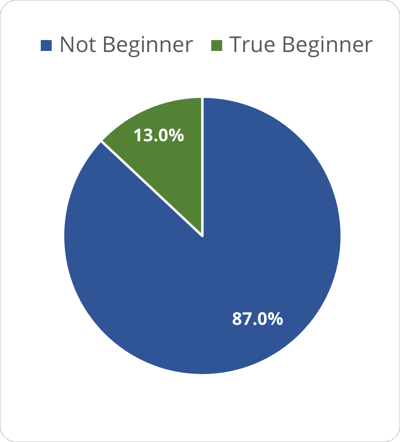
- Only 4 out of 30 pieces (13%) match true beginner level classifications.
- 87% align with intermediate or advanced grades in at least one formal system.
- Several “Beginner”-labeled pieces correspond to conservatory or diploma-level difficulty.
Notable mismatches between label and grading system:
| Piece | Composer | Grade |
|---|---|---|
| Gnossienne No. 3 | Erik Satie | RCM 8 |
| Prelude in C Major BWV 846 | J. S. Bach | AMEB 4 |
| Moonlight Sonata 1st mvt. | Beethoven | AMEB 7 |
| Hungarian Rhapsody No. 6 | Liszt | RCM ARCT |
| Prelude in C Minor BWV 999 | J. S. Bach | RCM 6 |
| Invention No. 6 BWV 777 | J. S. Bach | RCM 8 |
| Minuet in G major K.1 | Mozart | RCM 1 |
| Gymnopédie No. 1 | Erik Satie | RCM 8 |
| Waltz in A minor B 150 | Chopin | RCM 6 |
| The Nutcracker Suite No. 7 | Tchaikovsky | PS 10 |
The Most Misleading “Beginner” Pieces
Based on the largest gaps between platform labels and conservatory grading standards, the following pieces were the most misleading:
- Hungarian Rhapsody No. 6 → RCM diploma level
- Moonlight Sonata, 1st movement → AMEB Grade 7
- Invention No. 6 in E BWV 777 → RCM Grade 8
- Gymnopédie No. 2 → RCM Grade 8
- Liebesträum No. 3 → RCM ARCT level
Why this happens
Large sheet music platforms often rely on:
- User-generated content
- Automated categorization
- Popularity-based labeling
While this allows for massive libraries and accessibility, it also means that:
- Difficulty labels may not follow pedagogical standards
- Popularity can outweigh accuracy
- There is often no formal review process for level classification
As a result, difficulty labels are not always aligned with formal pedagogical standards and can become a very loose category.
Why it matters
For beginner pianists, choosing the right repertoire is critical. When pieces are mislabeled:
- Students may feel frustrated or discouraged
- Progress becomes harder to measure
- Teachers may need to correct expectations
In some cases, learners may abandon pieces or the instrument altogether, simply because the difficulty of the repertoire is beyond their technical ability.
About this study
This analysis reviewed 30 of the most-viewed piano scores labeled as “beginner” on major user-generated sheet music platforms, including MuseScore.
Each piece was compared against grading standards from established examination boards, including the Royal Conservatory of Music (RCM), AMEB, Trinity College London, and the independent database Piano Syllabus.
The goal of the study is to identify general trends in how “Beginner” labels align with widely used grading systems, rather than to evaluate any specific platform.
Data is based on publicly available information. Additional details are available upon request.
We analyzed 30 of the most popular classical piano pieces labeled as “Beginner” on a widely used sheet music platform to assess whether their difficulty matches formal grading standards.
A better approach to difficulty
Established systems like the Royal Conservatory of Music, Trinity College London or ABRSM provide structured, progressive frameworks based on technical and musical development.
Aligning repertoire with the student’s skill level helps ensure that:
- Pieces match the player’s ability
- Progress is consistent
- Learning remains motivating
- Playing the piano actually feels fun instead of frustrating
This analysis suggests that “Beginner” labels on large platforms should be approached with caution. While they offer convenience, they don’t always reflect the structured progression used in formal music education.